You can watch the order book without paying for software. Whether you should pay for something more depends on what you want the software to do: show you liquidity, or act on it under fixed rules.
What "free" usually covers
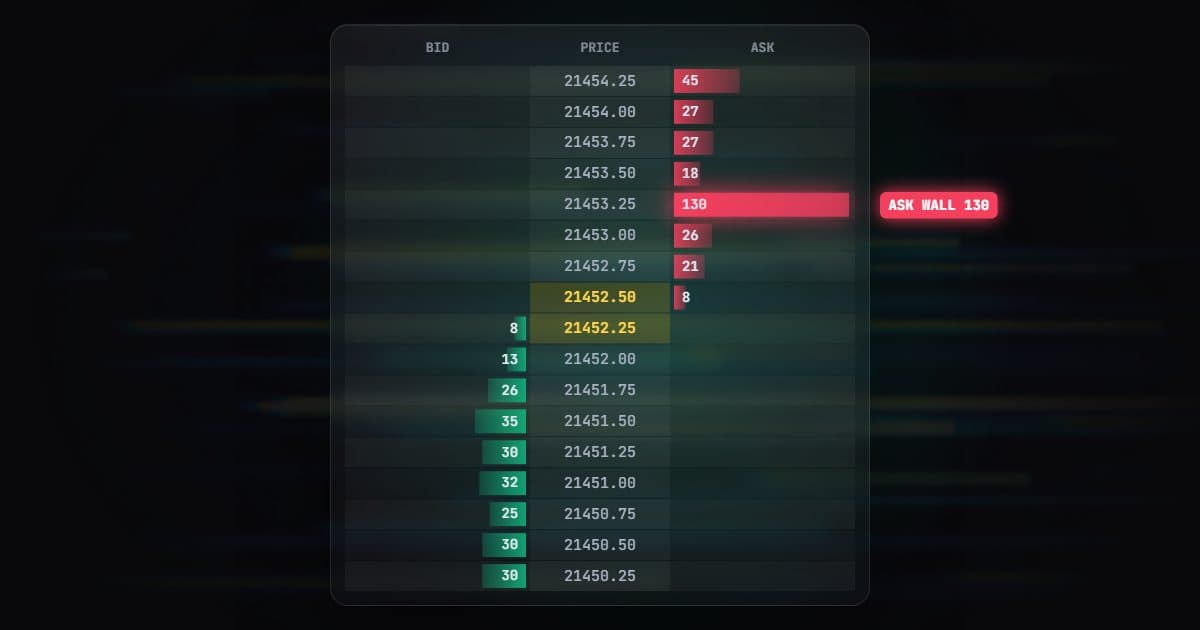
Most futures platforms include a price ladder that shows resting size at each price. In NinjaTrader 8 that is the SuperDOM. Many brokers' platforms have a similar depth window. Some charting vendors offer limited or trial versions of heatmap tools, and there are community scripts that colour depth or flag large orders.
One thing is rarely free: the data. Level 2 depth for CME futures generally carries exchange fees passed on by your data provider. Check what your feed includes before comparing any software, free or paid.
What free tools do well
- Learning. Watching a ladder for a few weeks teaches you how size behaves near price better than any article.
- Context. Seeing a heavy bid or a thin ask helps you judge a discretionary entry.
- No commitment. You can find out whether order-book trading suits you before spending anything on tools.
What they leave to you
A display shows liquidity. Everything after that is your job, and that is where most of the difficulty lives.
- Definitions. How heavy is heavy? For how long? Without numbers you judge each case differently.
- Speed. Book signals develop in fractions of a second. A pressure imbalance that holds for a quarter of a second is long by book standards and short by human standards.
- Tracking. Following several large orders at once, and noticing which were cancelled rather than filled, is hard to do by eye.
- Discipline. A free ladder will not stop you trading after your daily loss limit.
What a paid automated strategy adds
Vantedge BookPilot costs $399 per month. It is not a display with more colours; it is a NinjaTrader 8 strategy that turns two order-book patterns into rules and executes them.
- Pressure Break: summed size on the first 2 levels of one side at least 4 times the other, held for 250 ms.
- Pulled Wall: a large level near price removed without trading, scored for spoof probability and faded above 0.6.
- Limit entries placed behind the touch, cancelled after 3 seconds or if price runs away.
- Rules of Engagement, LOW / MEDIUM / HIGH risk presets, a daily profit goal and a daily max loss that lock the session, and a Flatten All button.
The plan includes the Vantedge BookScope and Vantedge Footprint indicators, plus the Vantedge DOM Pressure Matrix, a column for the SuperDOM itself rather than a chart indicator.
Weighing the cost honestly
A subscription is a fixed monthly cost on top of data fees and commissions. No strategy earns back its cost by default; some months it will lose money. The fair question is not "will this pay for itself" but "do I want these specific rules executed for me, and am I willing to test them properly first".
If you do not have Level 2 data, the cheaper Vantedge plan is FlowPilot at $299 per month, which trades footprint imbalances from tick data instead. The comparison page sets the two side by side.
A sensible path
- Start with the free ladder in your platform. Learn what normal depth looks like on ES or NQ.
- Write down the patterns you think matter, with numbers.
- If your patterns resemble what BookPilot trades, compare its definitions with yours.
- If you subscribe, run it on SIM and in Market Replay for several sessions before anything else.
Questions to ask before paying for anything
- Do I already have, or want to pay for, a Level 2 data feed?
- Can I describe the book patterns I trade in numbers, or only by feel?
- Have I broken my own daily loss limit in the last month?
- Will I spend the time to test a strategy in replay before trusting it?
Plenty of traders stay with free tools and trade by hand, and that is a reasonable choice. Automation is worth paying for only if you want the rules, not just the picture.
Whatever you use to read the book, futures trading can produce losses larger than you expect. Test in SIM and Market Replay before you trade an evaluation, funded or live account.