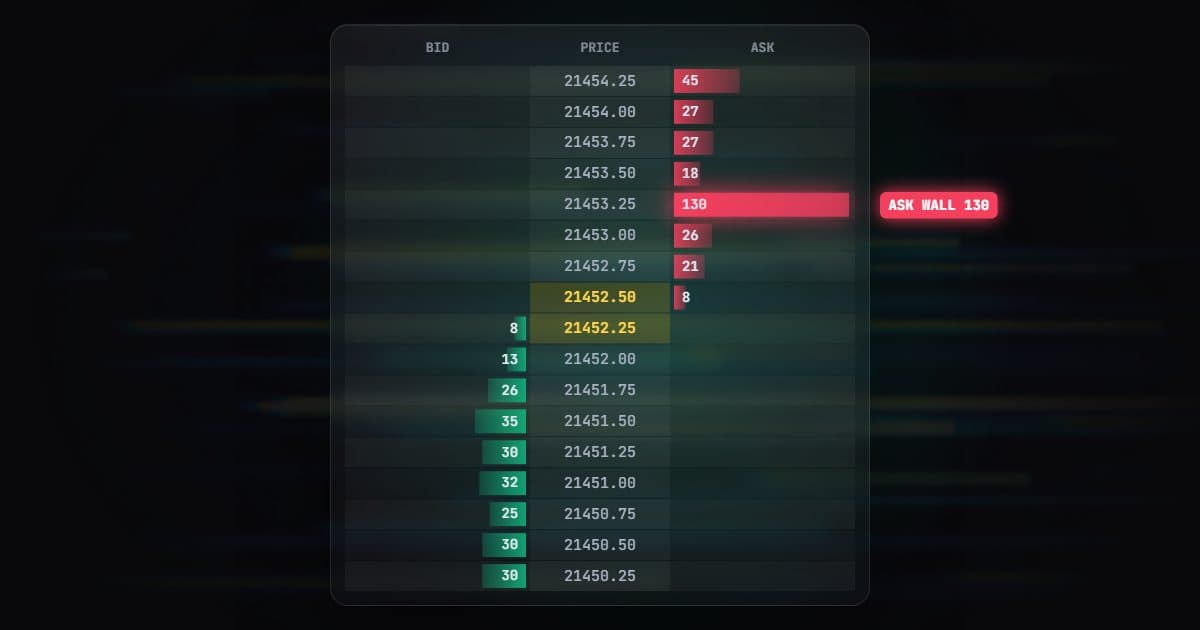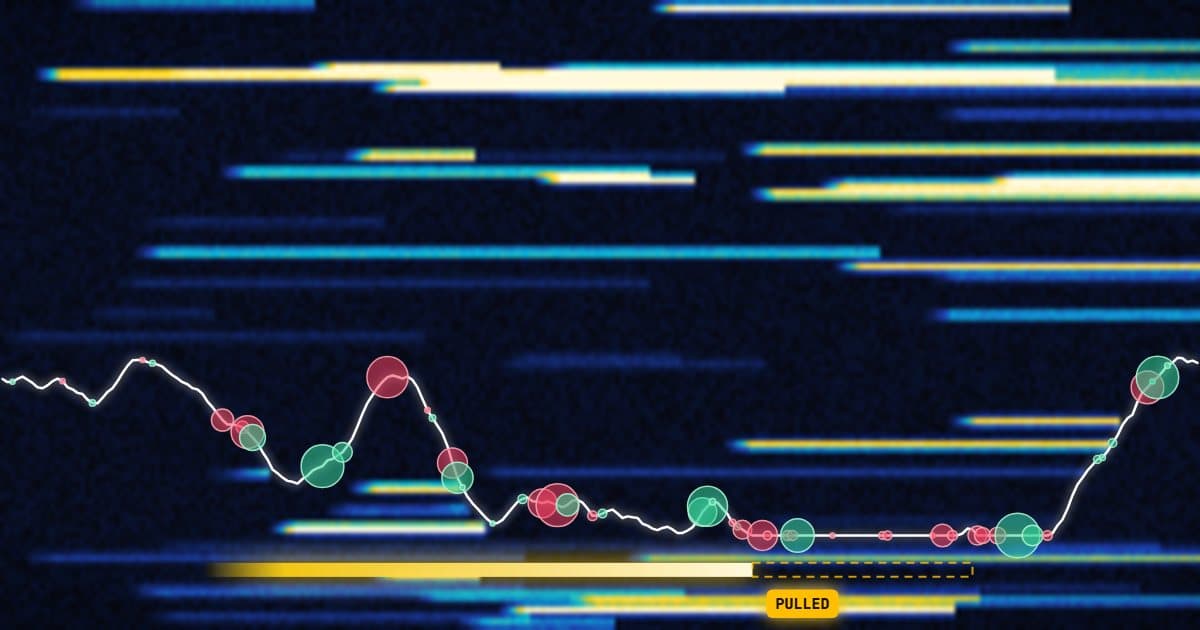

A snapshot of the order book tells you where size is resting right now. A liquidity tracker tells you what happened to that size: whether it was still there when price arrived, whether it traded, or whether it quietly disappeared. That history is what makes resting liquidity useful to a trader.
Why a snapshot is not enough
Imagine an NQ book with 180 contracts at one bid level and roughly 40 on each level around it. From a single snapshot you might decide there is support there. But you cannot tell whether that order has been sitting for ten minutes or arrived half a second ago, whether it keeps changing size, or whether it will still be there when price trades down to it.
Liquidity trackers answer those questions by remembering each significant order and updating its story on every depth change.
The life of a wall
Vantedge BookScope follows unusually large resting orders beyond the inside market through five states:
- Appeared: a level becomes large enough, relative to the levels behind it, to count as a wall.
- Approached: price comes within a set number of ticks of it (2 by default).
- Filled: the size trades. Whatever its intent, it was real liquidity.
- Pulled: most of it disappears without trading.
- Expired: it outlives the maximum tracking age and is dropped, by default after 30 seconds.
Only the pulled outcome becomes a trading signal. A wall pulled without trading is given a spoof probability between 0.0 and 1.0, and above the threshold the signal fades it: a pulled bid wall is a short signal and a pulled ask wall a long one.
What "large" means in a tracker
A good tracker measures size against the book around it, not against a fixed number. In BookScope and BookPilot a level counts as a wall when it is at least 2.2 times the average of the levels behind it. That adapts to the open, the lunch hour and the difference between ES and NQ without you changing anything.
Where it looks matters too. By default the scan covers the 3rd and 4th levels from the inside, because the best bid and ask change size constantly and would swamp the tracker with noise.
What you see on the chart
BookScope draws tracked walls as boxes, with pull marks when a wall is pulled. An on-chart DOM ladder flashes in the colour of the engine that fired, and signals get markers and alerts. Alongside, an info box shows the micro-forecast and the current bias.
BookScope is included with Vantedge BookPilot, the automated strategy that can trade the Pulled Wall fade with limit entries and fixed brackets. It needs a Level 2 market depth feed and runs in real time and in Market Replay.
Thinning: the other half of liquidity tracking
Tracking individual walls is one view. Another is watching whether a whole side of the book is draining. The Vantedge DOM Pressure Matrix, also included with BookPilot, shows that as a SuperDOM column rather than on the chart, with bid-ask pressure ratios at L3, L5 and L10 and level-thinning warnings when a side drains. Walls tell you about single orders. Thinning tells you about the side as a whole.
What no tracker can show
- Hidden size. Iceberg orders only show their visible slice, so a "small" level can absorb far more than it displays.
- Depth beyond your feed. NinjaTrader receives a limited number of levels per side. A tracker only knows about those.
- Intent. A pulled order can be a spoof, a market maker adjusting, or a trader changing their mind. The score describes behaviour, not motive.
- A stale feed. If depth updates stop, the picture freezes. BookPilot refuses to arm when no Level 2 update has arrived in the last 5 seconds, which is a sensible safeguard for any tracker.
Getting value from a tracker
Spend a few sessions in Market Replay just watching the boxes. Note how often walls fill, how often they are pulled, and what price does after each. The BookPilot user guide explains each wall setting (ratio, scan band, pull fraction, approach and age) so you can see how changing one reshapes what gets tracked.
Knowing where liquidity went does not tell you where price goes next, and futures can move against you quickly. Validate in Market Replay and on SIM before any evaluation, funded or live account.