The E-mini Nasdaq-100 trades in the same quarter-point ticks as ES but behaves very differently. Prices travel further, the book is thinner and patterns form and fail faster. Order flow analysis on NQ needs settings that respect that.
What makes NQ different
- Tick value. One tick is 0.25 index points, worth $5.00 per contract. The micro, MNQ, is $0.50 per tick.
- More ticks per move. NQ usually covers many more ticks than ES in the same time, so stops measured in ticks need more room.
- A thinner book. Each price usually holds less resting size, so the book changes shape quickly and individual large orders stand out more.
Footprint stacks on NQ
Because price moves through more levels, NQ footprint bars span more prices, and stacks of imbalances form more easily. A three-level stack is a smaller event on NQ than on ES.
The FlowPilot user guide reflects this. Its suggested Stacked Requirement is 3 to 5 on NQ, against 2 to 4 on ES, so you can ask for a longer push before entering. The suggested stop and target range is 16 to 40 ticks on NQ, against 8 to 16 on ES. The 16-tick default bracket, at $80 per contract on NQ, sits at the tight end of that range.
The range vote in FlowPilot's Auto regime is worth a thought too. It leans to Trend when the recent session range is wider than 3 times the bracket: 96 ticks with the default 16/16. Because NQ covers ticks faster, that bar is reached more often than on ES with the same bracket. Widening the bracket on NQ raises the bar in step.
Book signals on NQ
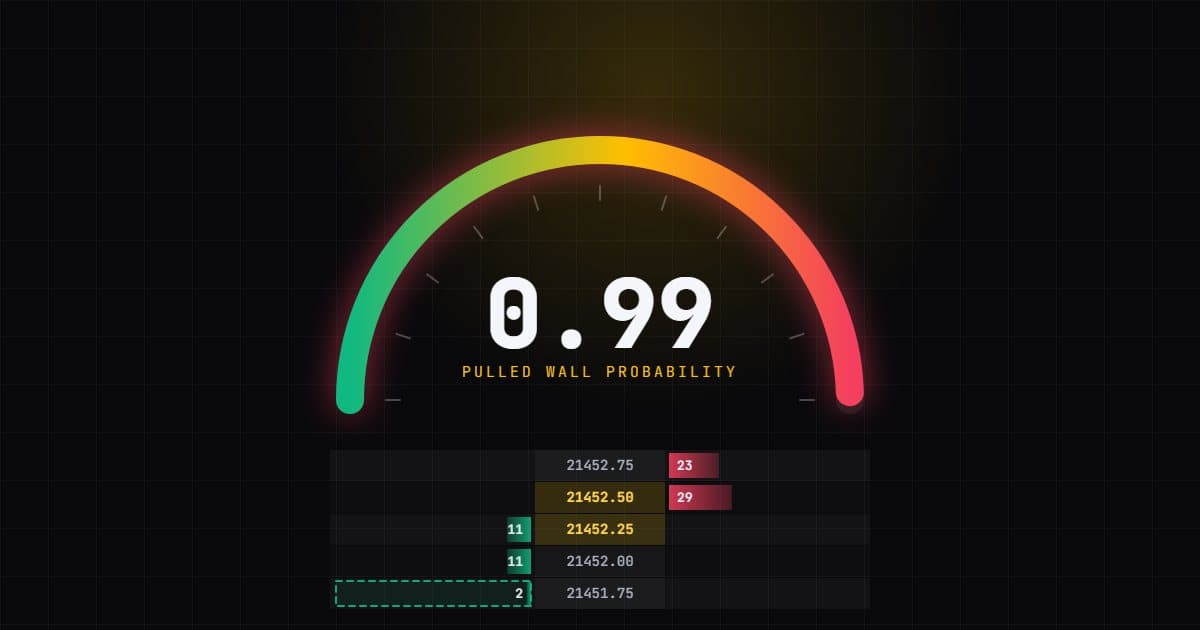
A thinner book cuts both ways. Imbalances and walls stand out clearly, but they are also easier to create and remove. Two practical consequences for Vantedge BookPilot:
- Brackets in dollars, translated to ticks. The default $150 target and $100 stop per contract are 30 and 20 ticks on NQ. BookPilot prints the conversion in the NinjaScript Output window when it starts.
- Filters earn their keep. With fast-changing size, the 250 ms hold on Pressure Break and the spoof veto at a score of 0.6 do more work. If you see many quick losses in replay, the guide's advice is to tighten the scanners with a higher ratio or a longer confirm.
The guide's suggested tick brackets for NQ, if you switch off dollar brackets, are 20 to 40 ticks for the target and 12 to 30 for the stop.
Micros: MNQ needs smaller dollar brackets
MNQ tracks the same index at a tenth of the value per tick. That matters differently for the two strategies:
- FlowPilot's bracket is in ticks, so 16 ticks is the same distance on MNQ; it is simply worth $8 rather than $80.
- BookPilot's dollar bracket is not. A $150 target on MNQ is 300 ticks away, which in practice means it rarely gets hit. Lower it to around $15 target and $10 stop, or switch to tick brackets.
The BookPilot guide lists exactly this in its troubleshooting section: a target or stop that looks far too wide on MNQ is the dollar bracket at work.
Sizing on a fast contract
NQ's speed tempts traders to size up because each tick is cheaper. Size to your daily limit instead. Both guides suggest keeping one full stop at no more than a third of the Daily Max Loss. With a 30-tick stop on NQ, that is $150 per contract. Against the default $750 max loss, a third is $250, so one contract fits and two do not.
Picking a strategy for NQ
Both strategies were built and tuned on ES and NQ. The comparison page sets out the difference: trade data and backtesting for FlowPilot, depth and Market Replay for BookPilot.
NQ can travel a long way in a few seconds, in either direction. Tune and observe on SIM, and in Market Replay for BookPilot, before an evaluation, funded or live account is involved.