
A DOM imbalance indicator compares the size resting on the bid with the size resting on the ask. The idea sounds simple, but a handful of design choices decide whether the number tells you something or just flickers. This article walks through those choices in NinjaTrader 8 terms and is clear about which Vantedge tools exist today.
What is being measured
The Depth of Market (DOM) shows limit orders that have not traded yet, level by level. NinjaTrader 8 receives this as market depth updates from a Level 2 data feed and displays it in the SuperDOM. An imbalance indicator adds up the size on each side over a chosen number of levels and compares the two totals.
If 400 contracts rest on the first two bid levels and 100 on the first two ask levels, the bid side is four times heavier. Whether that means anything depends on how the indicator is built.
The four choices that matter
How many levels to add up
Using only the best bid and ask is fast and sensitive, and very noisy. Adding more levels gives a steadier reading, but deeper size is easier to pull before price ever gets there. There is no single right depth. It is a trade-off between reaction speed and stability.
Ratio or difference
A ratio (bid size divided by ask size) works the same on a quiet book and a busy one. A raw difference in contracts does not: 200 contracts is a lot at lunch and very little at the open.
How long it has to hold
The book can swing from lopsided to balanced in milliseconds. An indicator that reacts to every flicker produces endless false alarms. A hold condition, where the imbalance has to persist for a set time, filters most of that out.
What it does about fake size
Some of the size in the book may be there to mislead. An imbalance built on a wall that is pulled a second later is not real pressure. Good tools either track walls or veto readings when the book looks spoofed.
How Vantedge handles DOM imbalance today
On the chart, the implementation is the Pressure Break scanner inside Vantedge BookScope and Vantedge BookPilot. Its defaults show each of the choices above:
- Depth: Pressure Break Depth 2, so the first two levels per side are summed.
- Ratio: one side has to be at least 4.0 times the other to start a candidate.
- Hold: the ratio has to stay at or above 2.5 for 250 ms (Confirm) before the signal fires. It does not fire again until the ratio drops back below the hold ratio.
- Fake size: a Pressure Break is vetoed while the book's spoof score is 0.6 or higher.
BookScope shows the signals on the chart, with an on-chart DOM ladder that flashes in the colour of the engine that fired, signal markers and alerts. BookPilot trades them automatically, with limit entries behind the touch and a $150 target and $100 stop per contract by default.
In the SuperDOM: the DOM Pressure Matrix
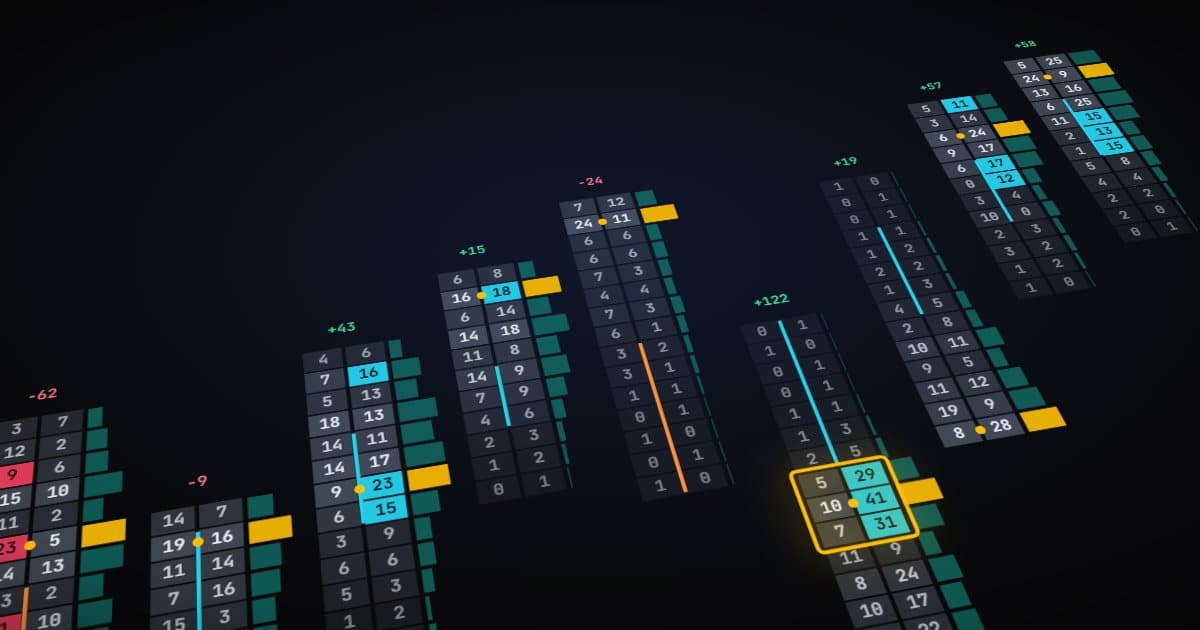
The Vantedge DOM Pressure Matrix is a dedicated DOM imbalance tool. It is a NinjaTrader SuperDOM column, not a chart indicator. It compares bid/ask depth ratios at L3, L5 and L10, highlights stacked pressure where large orders build up into a wall, and warns when one side of the book is thinning.
Looking at three depths side by side is the practical answer to the "how many levels" question above: you see whether the imbalance near the touch is backed further out, or exists only at L3. It is included in the BookPilot plan alongside BookScope and Footprint, and is not sold separately. The BookPilot product page and the capability matrix list what each plan contains.
Reading a DOM imbalance sensibly
- Compare readings at the same time of day. The open and the lunch hour have very different books.
- Watch whether the imbalance survives price approaching it. Pressure that disappears on contact was not pressure.
- Check the trades. An imbalance that coincides with aggressive volume in the same direction tells a stronger story than size alone.
- Remember what you cannot see: hidden size and anything beyond the levels your feed sends.
The BookPilot user guide lists how each Pressure Break setting changes behaviour if you want to experiment.
A DOM imbalance reading is a clue about the book, not a forecast you can bank on, and futures trading carries real risk. Test any setup in Market Replay and on SIM before it touches an evaluation, funded or live account.